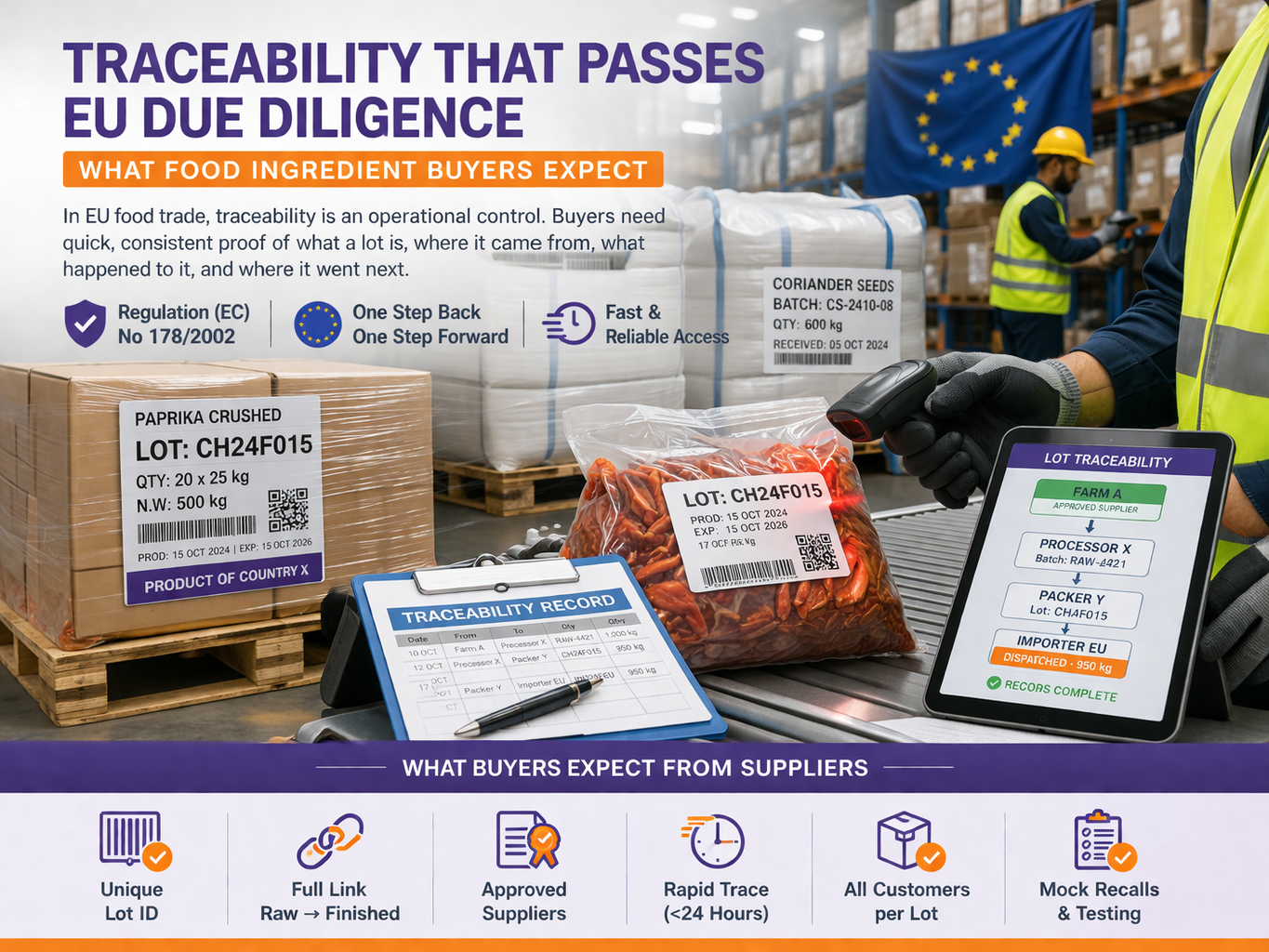
Traceability That Passes EU Due Diligence: What Food Ingredient Buyers Expect
In EU food trade, traceability is not a marketing line. It is a legal and operational requirement.
When a buyer asks where a lot came from, what it contains, where it went, and which records prove it, the supplier should be able to answer quickly and consistently. That is what traceability that passes EU due diligence looks like.
What EU buyers usually mean by traceability
Most EU buyers are not looking for a broad origin story. They are assessing whether a supplier can support legal traceability, product release, incident management, and targeted recall.
The legal backbone is Regulation (EC) No 178/2002, especially Article 18. It requires traceability of food, feed, food-producing animals, and substances intended to be incorporated into food or feed at all stages of production, processing, and distribution.
In commercial terms, the test is simple:
- Can you identify where the lot came from?
- Can you identify where it went?
- Can you retrieve the supporting records fast enough to help a buyer or authority act?
If the answer is slow, inconsistent, or fragmented, the system is probably weaker than the buyer needs.
The legal minimum: one step back, one step forward
Article 18 is often summarised as one step back, one step forward. Food business operators must be able to identify:
- the supplier from whom they received the product or relevant input
- the business customer to whom they supplied it
They must also have systems and procedures that make this information available to competent authorities on demand.
That is the legal minimum. In practice, buyers often expect more.
Why commercial due diligence goes beyond the legal minimum
The legal framework is designed to support food safety enforcement and recall. Commercial buyers, however, are also trying to manage broader operational and reputational risks.
That is why they typically want confidence that the supplier can handle:
- lot integrity
- specification consistency
- contamination investigations
- complaint handling
- authenticity concerns
- customer-specific segregation
- rapid document retrieval during audits or incidents
So while Article 18 sets the baseline, serious due diligence usually demands a more detailed, faster, and more disciplined traceability system.
What records matter in practice
European Commission guidance explains that, at minimum, businesses should be able to provide:
- name and address of supplier
- name and address of customer
- identification of the product
- date of transaction or delivery
The Commission also encourages keeping additional information that makes the system workable in real life, such as:
- batch or lot reference
- quantity or volume
- more precise product description
- links to internal production, packing, or dispatch records
For ingredient buyers, those additional fields are often what separates a paper-compliant system from one that actually works during an incident.
Fast traceability matters more than beautiful traceability
A supplier can have polished forms, clean dashboards, and lot codes on every label and still fail a serious traceability challenge.
What buyers really care about is speed and reliability. If there is a complaint, an MRL exceedance, an undeclared allergen concern, or a documentary inconsistency, they want a supplier that can produce a consistent evidence chain without delay.
That usually means being able to retrieve, by lot:
- incoming raw material records
- production or blending records
- packing records
- finished-goods release records
- COAs and test reports
- shipping and dispatch records
- customer allocation records
A system that needs two days and several conflicting spreadsheets to answer a basic lot query will not inspire confidence.
Traceability and recall readiness are directly linked
Under the General Food Law framework, food business operators also have obligations around withdrawal and recall of unsafe food. Traceability is what makes targeted action possible.
A strong system helps businesses avoid two different failures:
- under-reaction, where unsafe product remains in circulation
- over-reaction, where too much product is blocked because lot boundaries are unclear
Buyers value suppliers who can define affected lots precisely and act without confusion.
Official controls make this more than an internal admin task
Regulation (EU) 2017/625 provides the enforcement framework for official controls across the agri-food chain. That means traceability records are not just internal paperwork. They are records that may need to stand up to inspection, investigation, or import scrutiny.
So when buyers ask for traceability evidence, they are often asking a commercially translated version of the authority’s question:
Can this operator prove control of the product and its movement?
What good traceability looks like for ingredient suppliers
For food ingredient exporters, a traceability system that usually passes buyer due diligence includes:
- a unique lot or batch identification system
- clear linkage between incoming materials and finished lots
- supplier approval records for farms, collectors, processors, or intermediaries
- traceability across packing and dispatch dates
- the ability to identify all customers who received a specific lot
- document control that prevents mismatched specifications, COAs, or labels
- mock recall or trace exercises that demonstrate the system really works
If the product is blended, processed, repacked, or aggregated from multiple sources, buyers will expect that logic to remain intact through every stage.
Where multi-origin and aggregator models often break down
Many traceability failures do not come from bad intent. They come from commercial shortcuts, including:
- combining material from multiple farms without disciplined lot coding
- relabelling without preserving source references
- relying on broker paperwork that does not clearly tie to the physical goods
- testing one composite sample while shipping several operationally different lots
- changing warehouses, packers, or subcontractors without aligned records
These are exactly the weak points that tend to collapse under EU buyer scrutiny.
Why traceability is also a credibility signal
Strong traceability is not just about legal compliance. It is often a visible sign of how well the business is controlled overall.
A supplier who can clearly map lot history usually also handles specifications, complaints, and corrective actions better. A supplier who cannot explain lot history often has wider quality-system weaknesses.
That is why experienced buyers use traceability as both a compliance check and a credibility test.
What buyers should ask suppliers
- Can you complete a one-step-back/one-step-forward trace within hours, not days? Speed is a genuine test of control.
- What exact lot code appears on the shipped goods and on the documents? The physical chain and the paperwork must match.
- Can you link finished lots to raw-material inputs and production records? This is especially important for blended and processed ingredients.
- How do you manage multi-origin or aggregated supply? Ask where source visibility becomes less precise.
- Do you test the system with mock recalls or trace exercises? If yes, ask how often and what was learned.
- How quickly can you identify every customer that received an affected lot? This is a core incident-readiness question.
- Are quantity, batch, delivery date, and customer records connected in one working system? Fragmented recordkeeping often fails under pressure.
Practical takeaway
Traceability that passes EU due diligence is not about claiming to be “fully traceable” in a brochure. It is about being able to prove, quickly and consistently, what a lot is, where it came from, what happened to it, and where it went next.
For EU buyers, that level of control is not a premium feature. It is the baseline for safe, defensible sourcing.
Editorial caution
This article is intentionally practical and plant-ingredient focused. If the site will later cover animal-origin ingredients, it may be worth linking out to a separate note on the additional traceability rules under Commission Implementing Regulation (EU) No 931/2011.
Source basis
- Regulation (EC) No 178/2002, especially Article 18 on traceability and the broader withdrawal/recall framework
- EUR-Lex consolidated text for Regulation (EC) No 178/2002
- European Commission traceability factsheet and General Food Law materials
- Regulation (EU) 2017/625 on official controls
- Commission Implementing Regulation (EU) No 931/2011 for animal-origin traceability context where relevant