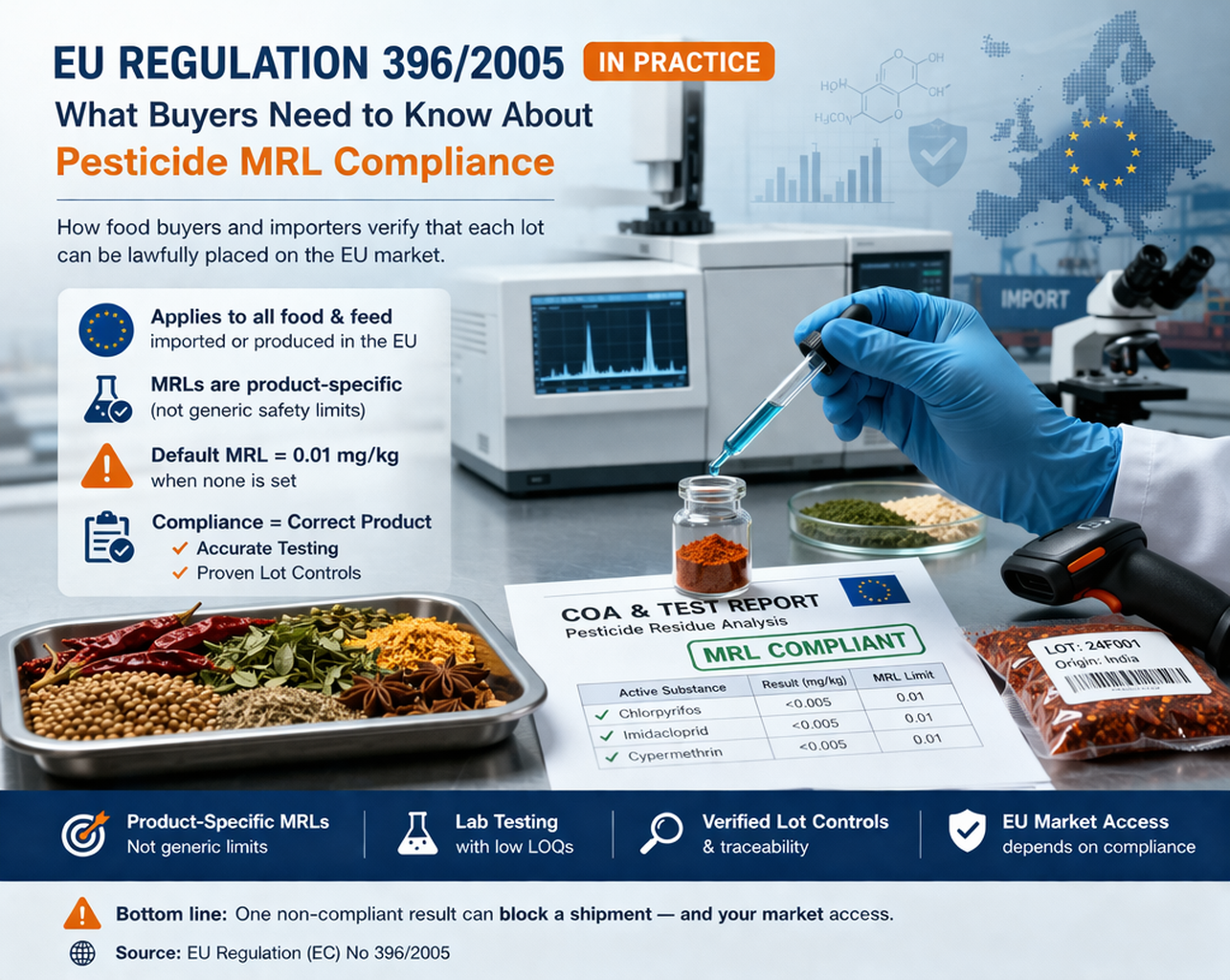
Regulation (EC) No 396/2005 on maximum residue levels is the rule EU buyers and import teams use when checking whether a food ingredient lot can lawfully enter the market.
Buyers do not need a legal lecture. They need to know which maximum residue levels apply, when the default 0.01 mg/kg position matters, and whether the supplier can support the lot with disciplined commodity mapping, testing, and traceability records.
If a consignment exceeds the applicable MRL, the commercial impact can be immediate: release delays, rejected shipments, intensified controls, customer escalation, or outright loss of marketability. That is why the practical issue is not simply whether a product has been tested. It is whether the lot, in the form sold, is compliant with the current EU legal limit for the correct commodity category.
Why this regulation matters in real buying decisions
Regulation 396/2005 harmonises pesticide residue limits across the EU for food and feed of plant and animal origin. It applies to EU-produced and imported products placed on the EU market.
For procurement, QA, and regulatory teams, that means residue compliance is tied directly to:
- product approval
- lot release decisions
- importer liability
- continuity of supply
- defensibility during audits and official controls
A residue issue is rarely just a lab problem. In practice, it is usually a sourcing, traceability, and supplier-control problem as well.
What the regulation actually does
At an operational level, the regulation does four important things:
- It sets harmonised MRLs for pesticide residues in covered food and feed products.
- It applies those rules equally to imported and EU-made goods placed on the EU market.
- It creates a default position where no specific MRL is established.
- It supports enforcement through the EU official control system used by Member States.
For buyers, the result is straightforward: compliance depends on the exact product category, the specific residue definition, the current legal limit, and the quality of the evidence supporting the shipment.
MRLs are product-specific, not generic safety numbers
One of the most important practical points is that an MRL is not a universal “safe or unsafe” threshold for a pesticide. It is a legal limit linked to:
- a specific active substance or residue definition
- a specific commodity or food/feed category
- the current version of the law, including amendments
That means a result that is acceptable for one product may be non-compliant for another. It also means old specification sheets and historic residue summaries can become misleading when legal limits change.
For commercial teams, this is where many avoidable errors begin: the test result may be real, but the legal interpretation may be wrong if the commodity mapping is off.
The default MRL of 0.01 mg/kg: small number, major risk
Where no specific MRL has been set, the regulation generally applies a default level of 0.01 mg/kg.
This default matters because it often turns a seemingly minor residue into a serious shipment risk. It is particularly relevant when:
- a pesticide is not authorised for the intended EU use
- the residue is unexpected for the commodity
- suppliers work to origin-country agricultural practice rather than EU market expectations
- sourcing is fragmented across multiple farms, aggregators, or seasons
In practical terms, “commonly used at origin” is not a compliance defence in the EU.
Imported goods are fully within scope
Non-EU origin does not create an exemption. If a product is being placed on the EU market, it must meet the MRL framework that applies in the EU.
For importers and buyers, this means domestic origin-country standards are not enough when they differ from EU limits. The supplier must be able to show that the actual lot complies with the EU requirement for the relevant commodity category.
Processed products, powders, and extracts need extra care
A frequent compliance mistake is to assume that if the raw material was compliant, the processed product is automatically compliant too. In practice, that is too simplistic.
Where a specific MRL is not laid down for a processed or composite product, the applicable position is generally derived from the corresponding raw commodity while taking account of the effect of processing or mixing.
That matters because processing can:
- concentrate residues
- dilute residues
- change how analytical results should be interpreted
- make raw-material-only certificates insufficient as a release basis
For dehydrated ingredients, powders, oleoresins, and extracts, the question should always be whether the analytical result and the legal interpretation reflect the product as sold into the EU.
The EU Pesticides Database is useful, but not the law
The European Commission’s EU Pesticides Database is the fastest practical tool for checking current MRLs by commodity and residue. It is highly useful for regulatory screening, sourcing checks, and internal triage.
But it is not itself the legal authority. The Commission states clearly that the database has no legal value. The official legal position remains the legislation published in the Official Journal of the European Union.
A sound buyer workflow is therefore:
- use the database to identify the likely current MRL and commodity mapping
- verify the legal basis when the issue is commercially material, disputed, or high risk
- document which legal source and date were used for the release decision
That discipline matters when a lot is challenged later.
Testing is necessary, but testing alone is not a compliance system
Residue testing is essential, but a COA on its own is not enough to prove consistent compliance.
Buyers should also check:
- whether the sample is representative of the shipped lot
- whether the method scope covers the residues relevant to the product and origin
- whether reporting limits are low enough for the applicable EU MRL, especially where the 0.01 mg/kg default may apply
- whether the laboratory is competent for the required residue panel
- whether the supplier can explain the agricultural and sourcing controls behind the result
A clean result on one batch does not compensate for weak farm controls, poor segregation, or inconsistent procurement practices.
Why official controls raise the commercial stakes
These rules are backed by the EU official control framework. In practice, non-compliant pesticide findings can trigger detention, rejection, increased border scrutiny, or wider review of a supplier’s future consignments.
This is why experienced EU buyers increasingly ask for more than an end-product pesticide report. They want evidence that the supplier’s upstream system makes repeated compliance likely, not accidental.
What stronger suppliers do differently
Suppliers that are genuinely ready for EU business usually have more than a testing routine. They typically operate with:
- approved farm, collector, or aggregator programmes
- restricted pesticide lists aligned to EU market requirements
- pre-harvest or pre-dispatch screening for higher-risk products
- lot segregation and traceability
- corrective action processes when seasonal or source-related drift appears
- a defined process for reviewing changes in EU MRLs
No system removes all risk. But disciplined controls materially reduce avoidable surprises.
What buyers should ask suppliers
- Which exact EU commodity category are you using for this product? This helps prevent mismatches between the tested product and the legal classification.
- Which residues are included in your analytical scope, and why? The panel should reflect both origin-country use patterns and EU exposure history.
- What are the method LOQs? Results are far less useful if the reporting limit is too high for the relevant MRL.
- Is the COA linked to the shipped lot? Typical data, pooled results, or broad annual summaries are not a sound release basis.
- How do you monitor changes in EU MRLs? Someone in the supply chain needs to be tracking legal updates.
- What controls exist before harvest or procurement? End-product testing is weaker than controlled sourcing.
- How do you assess concentrated or processed forms? This is especially important for powders, extracts, and oleoresins.
FAQ: Regulation (EC) No 396/2005 in practice
What is the default MRL under Regulation (EC) No 396/2005?
Where no specific MRL is set, the regulation generally applies a default level of 0.01 mg/kg. That small number can create a real shipment risk if the wrong commodity mapping or residue expectation is used.
Does Regulation (EC) No 396/2005 apply to imported spices and ingredients?
Yes. Imported goods placed on the EU market are within scope, so non-EU origin does not create an exemption from the applicable residue limits.
Why do processed ingredients need extra care under the MRL framework?
Because powders, extracts, and oleoresins can concentrate or otherwise change how residues should be interpreted. Buyers need the legal assessment and analytical result to reflect the product form as sold.
Practical takeaway
EU Regulation 396/2005 is best treated as a marketability rule backed by testing, traceability, and enforcement.
The strongest buying question is not, “Do you have a pesticide report?” It is this:
Can this exact lot, in this exact product form, be lawfully placed on the EU market under the current MRL framework?
That is the standard importers and buyers should build into supplier approval, technical review, and lot release decisions.
This article explains Regulation (EC) No 396/2005 in practical terms. It is not a substitute for product-specific legal advice — always confirm current MRLs against the EU Pesticides Database and the consolidated legal text for your exact commodity.
Source basis
- Regulation (EC) No 396/2005 of the European Parliament and of the Council of 23 February 2005 on maximum residue levels of pesticides in or on food and feed of plant and animal origin
- EUR-Lex consolidated/legal text pages for CELEX:32005R0396
- European Commission EU Pesticides Database
- European Commission materials on official controls and Regulation (EU) 2017/625