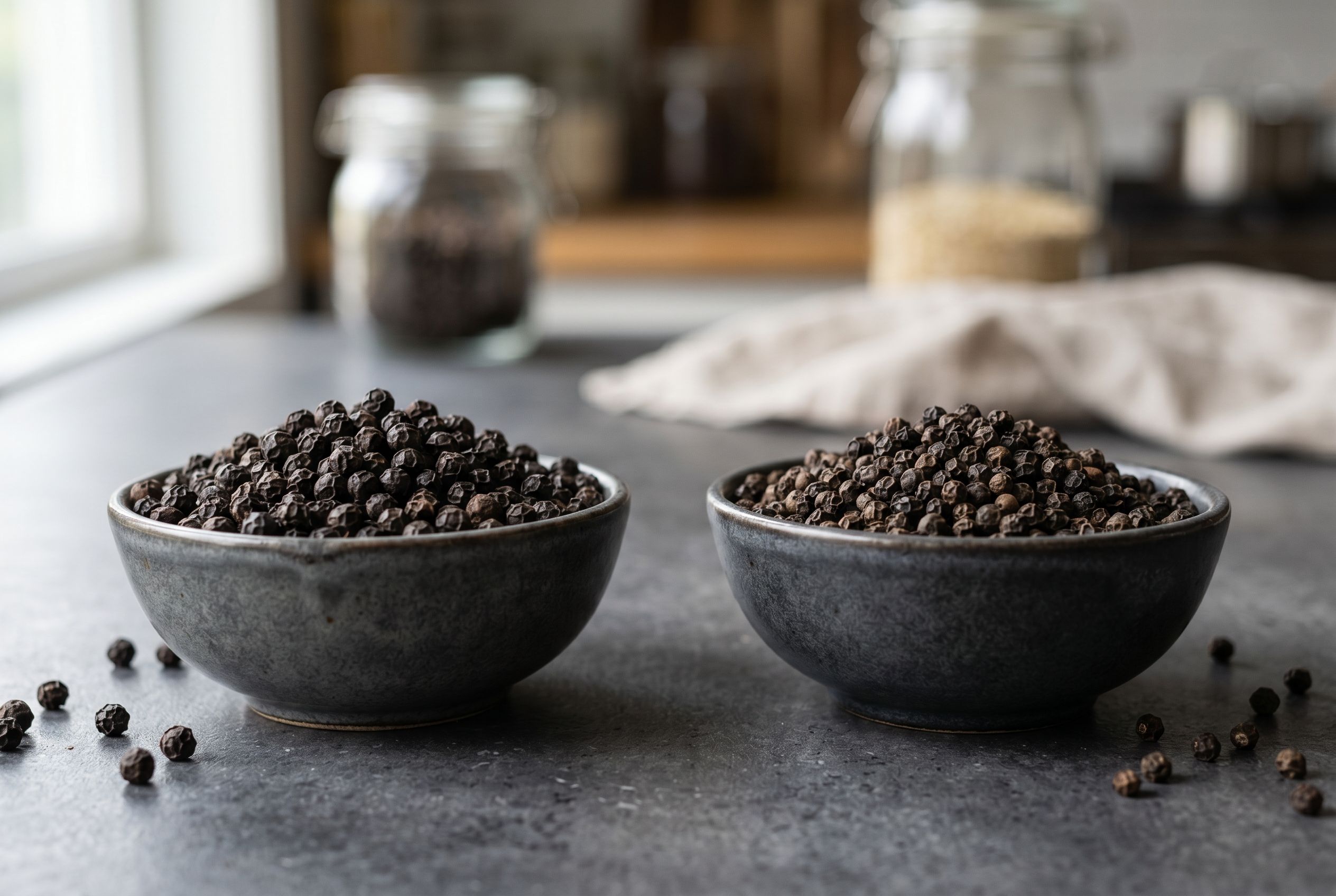
Despite how they sound, Tellicherry and Malabar don't tell you where the pepper was grown. Pepper picked in Idukki, up in Kerala's high ranges, nowhere near a coastline, gets sold under both names — exactly like pepper from Wayanad or the coastal belt near Kannur. These are not two different peppers from two different places. What separates them happens after harvest, on the sorting floor — and that one step is what decides whether a lot ends up as TGEB, TGSEB, or a standard Malabar grade like MG1.
Most buyers get tripped up here because the names sound like a quality ladder — as if Tellicherry is simply "better" and Malabar is the budget option. It isn't that simple, and treating it that way is how buyers end up either overpaying for a boldness their product never shows off, or underbuying a grade that quietly costs them on flavour and consistency.
The real question is narrower: does your product need the pepper to look big and bold, or does it need the pepper to perform — pungency, aroma, reliability — without anyone ever seeing the whole berry? Answer that, and the choice between Tellicherry and Malabar mostly makes itself.
What is Tellicherry pepper — and what do TGEB and TGSEB mean?
The name comes from Thalassery — the British spelled it "Tellicherry" — an old pepper-trading port on the Kerala coast. But the name has long since outgrown the port. It makes no difference today whether the raw pepper was harvested near the coast, up in Idukki, or in the Wayanad hills: "Tellicherry" is simply what a lot is called once it has been sorted and held back for its largest, most fully matured berries. Growing location doesn't enter into it.
That sorting is done through sieves, measured in millimetres, and it produces two grades buyers see most often:
TGEB (Tellicherry Garbled Extra Bold) is the first bold cut — berries that have cleared roughly 4.25mm on the sieve. TGSEB (Tellicherry Garbled Special Extra Bold) is a step up from that, holding back only the berries above roughly 4.75mm. In plain terms: TGSEB is the bigger, bolder berry of the two, and the one with the tighter sort. Both are "garbled," meaning stalks, light berries, and other debris have already been cleaned out.
The difference between TGEB and TGSEB isn't a difference in origin or flavour — it's a difference in how far up the sieve the pepper was pushed before someone decided it was bold enough to earn the higher grade.
What is Malabar grade pepper, and where does MG1 fit?
Malabar grade pepper can start out as the exact same harvest as Tellicherry — same vines, same season, grown anywhere across Kerala or the neighbouring pepper belts in Karnataka and Tamil Nadu, coastal or inland. It's picked and cleaned (garbled) the same way. What it skips is the size sort. Instead of being pushed through sieves to isolate the boldest berries, Malabar pepper is judged mainly on density — what traders call GL, or grams per litre — and on how clean and consistent the lot is.
MG1 (Malabar Garbled 1) is the grade most buyers mean when they say "Malabar pepper." It's a mix of berry sizes rather than a single bold cut, but that mix can still carry excellent density and a strong, pungent flavour. It's simply not being sold on how it looks — it's being sold on how it performs.
This is worth sitting with for a second: MG1 isn't Tellicherry's lesser cousin. It's a different sorting decision made on the same raw material, aimed at a different job.
Tellicherry vs Malabar: what actually changes when you switch?
Two things change — what you're paying for, and what the pepper is expected to do once it arrives.
With Tellicherry, whether TGEB or TGSEB, you're paying partly for size and visual boldness. That premium earns its keep when the berry is seen — in a jar, a grinder, a chef's hand, a retail pack where the customer is judging quality by eye before they ever taste it.
With Malabar and MG1, you're paying for reliable pungency and density at a more efficient cost, without carrying a size premium the product won't show off. That's the right trade when the pepper disappears into something else — a blend, a ground spice mix, a manufacturing line — where nobody will ever see an individual berry.
Neither is the "upgrade." They're two answers to two different questions.
When TGEB or TGSEB is the right call?
Reach for Tellicherry when the pepper is going to be looked at, not just tasted:
- retail whole-pepper packs and grinder fills
- gourmet or chef-facing lines where presentation matters
- private-label products built around a premium origin story
- any format where the buyer sees the actual peppercorn before they buy
Between the two, TGSEB is worth the extra step up when the packaging or format puts the berry front and centre — a clear jar, a premium grinder — and every millimetre of boldness is doing visible work. TGEB earns its place when you want that same bold Tellicherry character at a slightly gentler price, and the difference in berry size won't be scrutinised as closely.
When Malabar or MG1 is the smarter buy?
Malabar and MG1 tend to be the better commercial decision when:
- the pepper goes into a seasoning blend or spice mix
- it's ground, extracted, or processed before it reaches the end customer
- the finished product never shows a whole berry
- the buying team is managing cost across a wider formulation, not just the pepper line
Here, paying extra for size would be paying for something the product structurally can't use. A well-cleaned, consistent MG1 lot with good density will usually outperform an oversized-but-unnecessary Tellicherry grade on cost per unit of actual flavour delivered.
Before you approve a lot: what to actually check?
The grade name gets you into the conversation, not out of it. Whether it's TGEB, TGSEB, or MG1, the sample in front of you still needs to earn the label. Before signing off, it's worth checking whether the pepper is visible in the finished product at all, whether the sieve size or density actually matches what the grade claims, whether the lot is consistent from top to bottom of the bag rather than front-loaded with the best berries, and whether the supplier can back the offer with proper documentation. A grade name on a spec sheet is a starting point. The physical lot is what you're actually buying.
Tellicherry vs Malabar: the short version
If the pepper needs to look premium — bold, visible, part of the sell — go Tellicherry, and pick TGSEB over TGEB when every bit of extra size matters to how the product presents. If the pepper needs to perform inside a blend, a mix, or a manufacturing line where nobody sees the berry, Malabar grade — typically MG1 — usually does the job for less, without giving up flavour.
Same crop, same growing belt, two different sorting decisions — and neither name is telling you which district it came from. The right one depends on what happens to the pepper after it leaves your warehouse, not on which name sounds more impressive.
If your team is weighing Tellicherry against Malabar grade — or trying to work out whether TGEB, TGSEB, or MG1 fits a specific product line — Four Squares can help match the grade to the application rather than the other way around.