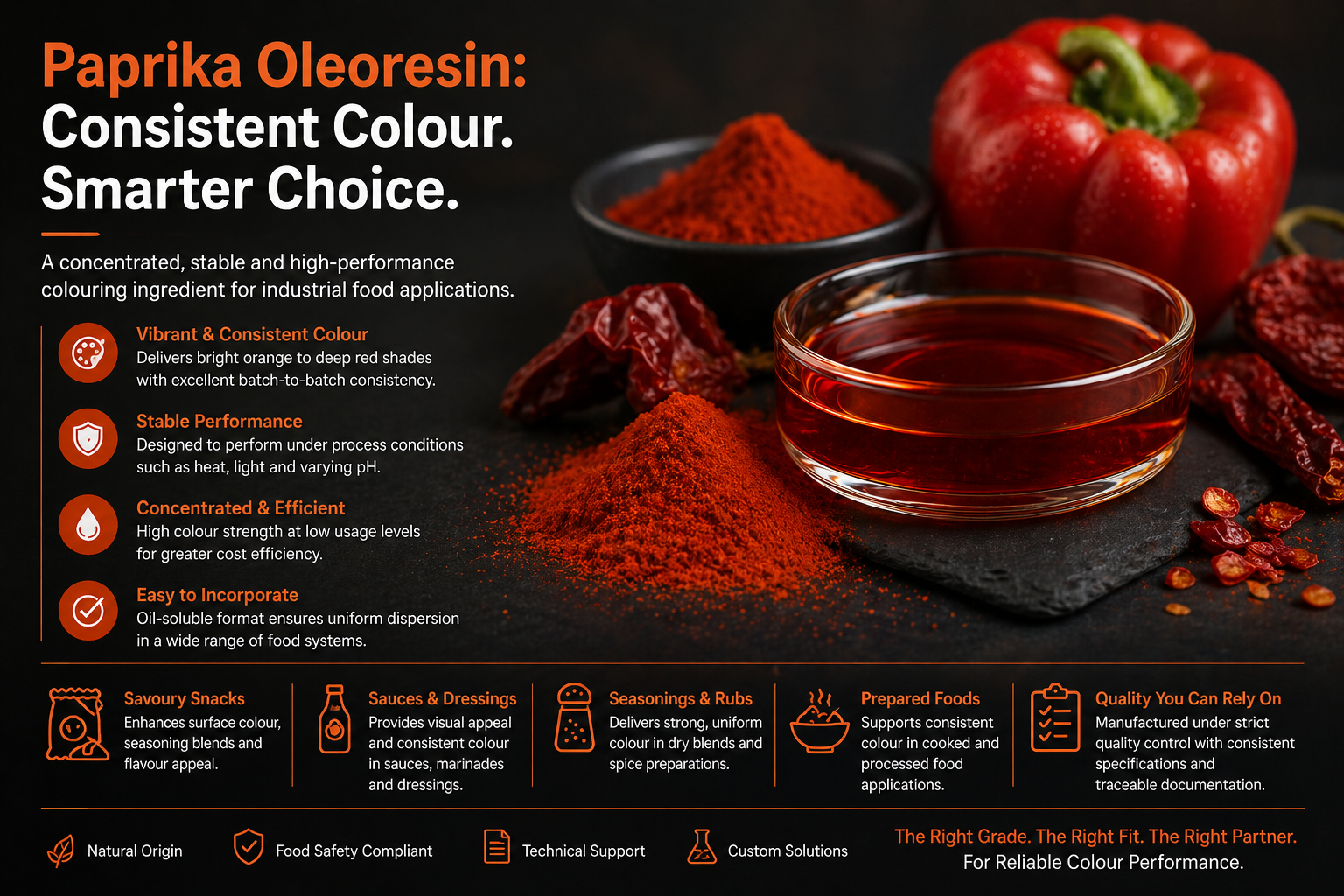
Paprika oleoresin is not just a colour input. In industrial food systems, it is part of a commercial decision about consistency, process fit, and how cleanly a product team can move from development work into repeat production.
That matters because visual performance still does serious commercial work. Across savoury snacks, seasonings, sauces, coatings, and prepared foods, colour influences first impression, flavour expectation, and batch-to-batch product recognition. If the colour profile drifts, the product looks less controlled even when the underlying recipe has not changed.
This is where paprika oleoresin keeps its value. It gives manufacturers a concentrated orange-to-red colour tool that can be selected more deliberately than raw paprika powder in many industrial settings. But the useful buyer question is not whether paprika oleoresin sounds attractive. The real question is whether the right grade fits the application, the process conditions, and the commercial expectation behind the finished product.
Why paprika oleoresin still matters in industrial food applications
Manufacturers do not buy paprika oleoresin for theory. They buy it because it can help create a repeatable visual outcome in a system that has to scale.
That can mean supporting a stronger red-orange tone in a snack seasoning, tightening visual consistency in a sauce line, or helping a savoury product hold a more deliberate finished appearance across production cycles. In each case, the ingredient is doing more than adding colour. It is helping protect the product’s market presentation.
Paprika oleoresin also matters because it gives industrial teams more control over strength and format selection. Instead of relying only on the natural variation of whole spice inputs, buyers can evaluate more standardized colour delivery and match the ingredient more closely to the intended use case.
For commercial teams, that matters because colour inconsistency creates downstream cost. It can slow approvals, trigger internal reformulation work, complicate scale-up, or weaken buyer confidence in the supplier relationship. A well-matched oleoresin grade helps reduce that friction.
What buyers should evaluate before selecting a paprika oleoresin
A disciplined buyer review usually starts with four questions.
First, what colour outcome is the team actually trying to achieve? “Paprika oleoresin” is not a complete application brief. Buyers need to know whether they are aiming for a bright orange-red lift, a deeper warm red tone, or support for a broader seasoning or sauce colour architecture.
Second, what process environment will the ingredient face? Heat load, fat phase, mixing conditions, hold time, and the structure of the product matrix all affect how an oleoresin performs in real manufacturing conditions.
Third, what format best fits the application? In some systems, an oil-soluble format may be straightforward. In others, dispersion behaviour or incorporation logic may push the conversation toward a more application-specific format.
Fourth, what level of specification support and documentation discipline does the supplier bring? A supplier who can only talk in broad colour language is weaker than one who can frame the discussion around grade fit, specification clarity, and controlled documentation support.
Application fit matters more than generic colour claims
Paprika oleoresin works across a broad set of product categories, but that does not mean one commercial message fits all of them.
In savoury snacks and seasoning systems, the conversation may focus on colour strength, distribution, and how the ingredient behaves on the finished product surface. In sauces, marinades, and dressings, dispersion behaviour and matrix interaction may matter more. In prepared foods or processed savoury systems, repeatability and line-to-line consistency may become the bigger commercial issue.
That is why strong supplier conversations stay specific. Buyers should be able to ask which applications a grade is intended to support, what performance variables deserve attention, and where the ingredient may need closer technical review before it is advanced into a larger development or qualification step.
A supplier who understands those application realities is more useful than one who simply repeats that paprika oleoresin is natural or commercially attractive. Industrial buyers already know it is attractive. What they need is a disciplined explanation of fit.
Standardization, process logic, and supplier quality all connect
One of the core commercial advantages of paprika oleoresin is standardization. Natural ingredients always carry some raw-material variability, but industrial buyers still need a product they can review, qualify, and reorder with confidence.
That makes supplier quality systems important. Buyers should look for clarity around specification ranges, product handling, batch-linked documentation pathways, and how the supplier frames technical support during evaluation. They should also look at whether the supplier can keep the conversation grounded in practical manufacturing logic instead of overpromising broad outcomes.
This is especially relevant when a product team is under pressure to move quickly. Fast-moving projects often fail when the ingredient conversation stays vague too long. A disciplined supplier helps the buyer narrow the discussion to the right grade, the right application path, and the right next-step documentation.
What a productive supplier conversation should cover
Before a buyer moves forward, the supplier discussion should usually cover:
- intended product application
- target visual outcome
- process conditions that could affect performance
- likely grade or strength fit
- specification clarity
- documentation path for technical and commercial review
- readiness for sample, quote, or further application discussion
That is the level where paprika oleoresin stops being a generic ingredient label and becomes a commercially workable solution.
The commercial takeaway
Paprika oleoresin remains valuable because it helps industrial food teams solve a real problem: how to achieve stronger colour consistency without losing control of application fit and supplier qualification.
The winning move is not to treat it like a trend story. It is to evaluate it as a process-fit ingredient. Buyers should review the intended application, the processing environment, the strength or format requirement, and the supplier’s ability to support a disciplined technical-commercial conversation.
For the right food system, paprika oleoresin can be more than a colour source. It can be part of a more controlled, more repeatable product strategy.
If your team is reviewing paprika oleoresin for snacks, sauces, seasonings, coatings, or other industrial food applications, talk to Four Squares about current-stock options, application fit, and specification support before you move to the next qualification step.