Overseas spice buyers do not need vague country-of-origin reassurance. They need structure.
The real sourcing question is not whether a national label can guarantee every shipment. It cannot. The better question is whether the exporting country has formal systems that help reduce buyer risk, improve documentation, and make supplier claims easier to verify.
In India’s case, the answer is yes.
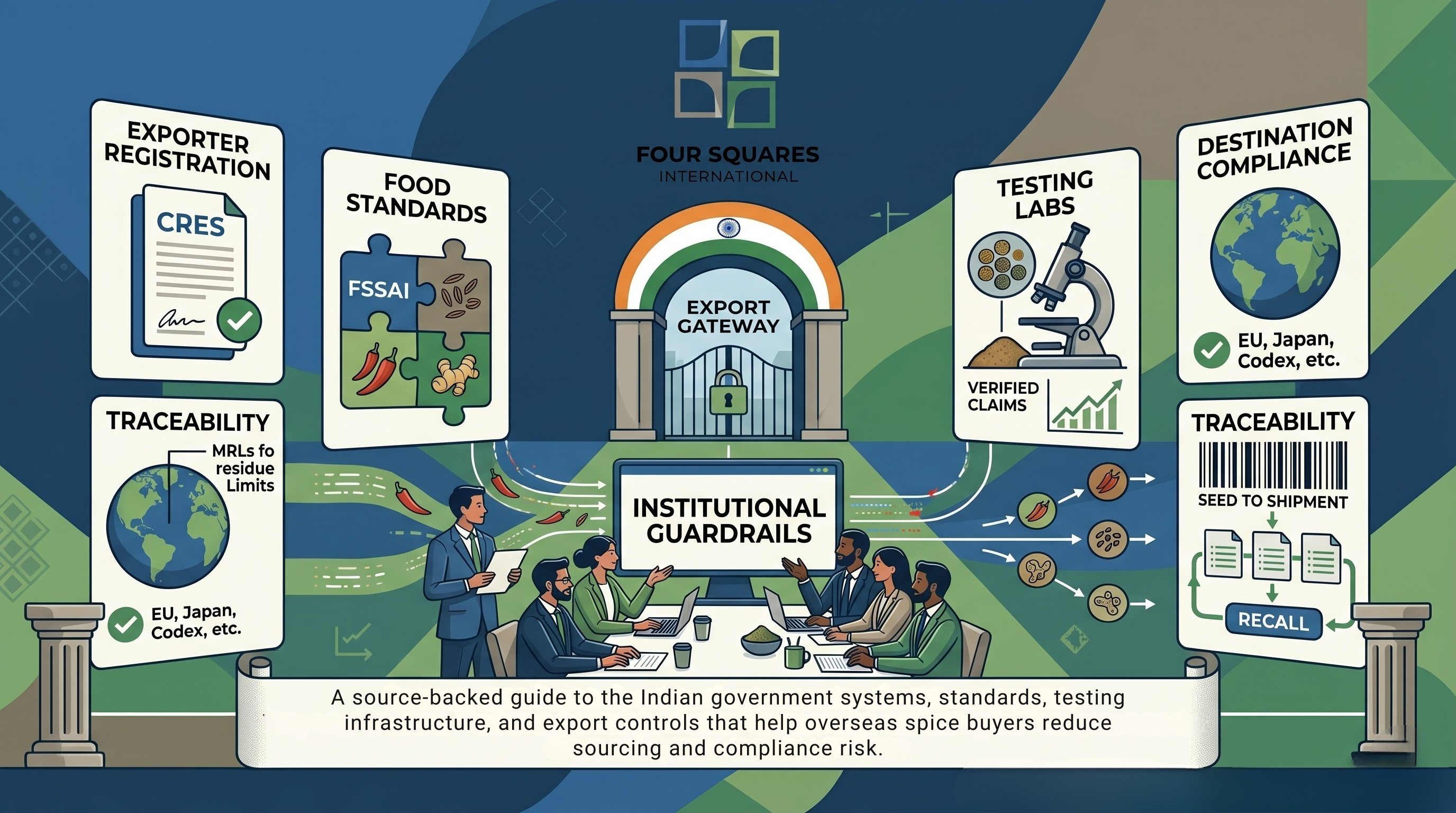
India’s spice export environment is supported by a public framework that includes exporter registration, published food standards, spice-specific food-safety guidance, laboratory infrastructure, sanitary and phytosanitary references, and export-support systems tied to destination-market requirements. For importers, procurement teams, private-label brands, and ingredient buyers, that matters because it creates institutional guardrails around quality, safety, and traceability, even though buyer-side due diligence still remains essential.
This is where India’s official system helps, where it does not, and what overseas buyers should actually look for.
Why serious spice buyers should care about formal systems
India is one of the world’s largest spice producers and exporters. That scale creates opportunity, but it also creates variation. Large sourcing markets attract excellent suppliers, average suppliers, and weak suppliers at the same time.
Serious buyers therefore look for more than crop stories, attractive pricing, or export experience claims. They want to know whether the sourcing environment itself has formal controls.
That is where India’s government-linked spice framework becomes commercially relevant.
Its value is not that it removes all risk. Its value is that it creates a more structured export environment. Exporters operate within recognized registration channels. Food businesses are expected to follow published hygiene and safety rules. Product standards are codified. Testing infrastructure exists. Official guidance points exporters toward importing-country residue and SPS requirements.
In practical terms, that gives overseas buyers a stronger base for verification than a purely informal trading ecosystem would.
Exporter registration is the first official filter
One of the first institutions relevant to overseas spice buyers is the Spices Board, under the Ministry of Commerce and Industry.
The Spices Board requires exporters of spices to obtain a Certificate of Registration as Exporter of Spices, commonly referred to as CRES. For overseas buyers, this does not mean that every registered exporter is automatically the right supplier. It does mean that spice export activity is expected to pass through a formal registration framework rather than a completely unstructured market.
That matters for two reasons.
First, it gives buyers a basic legitimacy check. Before discussing detailed product specifications, testing protocols, or shipment terms, a buyer can ask whether the exporter is properly registered within the Indian spice export system.
Second, it signals that the Indian export environment is not designed to operate entirely on informal promises. There is an official channel through which exporters are expected to enter the trade.
The Spices Board also publishes a trade enquiry interface for foreign buyers. That is useful not because it replaces sourcing work, but because it shows how Indian export trade is expected to be conducted: with declared product requirements, country details, quality expectations, and specification-driven communication rather than vague buying requests.
Published spice standards create a clearer baseline
A major safeguard for overseas buyers is that India does not leave spice identity and baseline quality entirely undefined.
The Food Safety and Standards Authority of India (FSSAI) publishes legal product standards for a wide range of whole and ground spices. These standards cover parameters such as moisture, ash values, volatile oil content, extraneous matter, insect-damaged matter, foreign matter, and other product-specific quality indicators.
For buyers, this matters because it creates a public reference point for what many spice products are supposed to look like when properly described and sold within the Indian regulatory framework.
For example, FSSAI standards set measurable limits and identity criteria across products such as cumin, coriander, chilli, ginger, cardamom, cinnamon, cloves, fennel, fenugreek, turmeric, and others. In several cases, the standards also reinforce what the product must be free from, including mould, rodent contamination, harmful substances, and unauthorized added colouring matter.
This does not replace a buyer’s own specification sheet. Importers will still define their own microbiological, residue, physical, allergen, and market-specific requirements. But published national standards help reduce ambiguity and create a common starting language for supplier qualification and product description.
Food-safety controls go beyond product definitions
One of the strongest institutional safeguards for overseas buyers is that India’s official framework is not limited to end-product standards alone.
FSSAI has also issued a detailed Food Safety Management System guidance document for spice processing. This matters because it shows how Indian regulators expect spice-processing facilities to think about food safety in operational terms, not just in finished-goods language.
The guidance covers areas such as:
- supplier approval and monitoring
- raw material inspection and rejection criteria
- cleaning and sanitation
- pest control
- control of moisture and mould risk
- segregation of raw and treated material
- microbial reduction treatments where necessary
- packaging and warehousing controls
- traceability and recall procedures
- quality control and laboratory testing
- employee hygiene and training
- record keeping and audit readiness
For overseas spice buyers, this is highly relevant. It means that the public regulatory architecture recognizes the real causes of shipment failure: contamination, poor storage, inadequate process control, weak hygiene, improper handling, and poor records.
In other words, the Indian system does not treat spice quality as a decorative marketing issue. It treats it as a control issue.
Traceability, recall, and documentation are real buyer safeguards
Many importers focus heavily on certificates but underestimate the operational importance of traceability and recall readiness.
The FSSAI spice-processing guidance addresses both. It calls for records of incoming materials and their sources, segregation of non-conforming materials, stock rotation practices such as FIFO and FEFO, process monitoring, documentation retention, and written recall procedures.
For a foreign buyer, these are not abstract compliance terms. They affect what happens when a shipment is questioned, when a market asks for supporting documents, when a lot needs backtracking, or when a contamination event has to be investigated quickly.
An exporter who works inside such a framework is in a better position to support a buyer with lot history, supplier data, production records, and corrective explanations than an exporter operating with weak documentation discipline.
This is one of the least glamorous but most valuable ways in which formal government systems help safeguard overseas buyers.
Testing infrastructure makes quality claims more verifiable
Another major buyer safeguard is the role of the Spices Board’s quality infrastructure.
The Spices Board publishes information on Quality Evaluation Laboratories, analytical services, and empanelled laboratories. This matters because it gives exporters and buyers access to recognized testing channels for quality and safety parameters relevant to spice trade.
For overseas buyers, laboratory infrastructure matters in a practical way. A supplier claim becomes stronger when it can be supported by recognized test reports. A pre-shipment discussion becomes more productive when there is a clear path for analytical verification. A dispute becomes easier to handle when both parties can point to formal test parameters rather than opinion.
The Spices Board also publishes a mandatory tests for export framework. Buyers should be careful not to over-interpret this. It should not be read as proof that every shipment is automatically tested for every conceivable parameter. But it does show that export-facing testing expectations are organized and publicly referenced rather than hidden or improvised.
That is useful for serious buyers who want to align purchase conditions, certificates of analysis, and lot-specific documentation with known export-control logic.
SPS and MRL guidance shows destination-market awareness
One of the biggest risks in spice importing is assuming that a product is acceptable just because it is commercially available in the origin market.
That assumption fails quickly when import tolerances differ across countries.
A strong feature of India’s export-support framework is that official institutions explicitly acknowledge destination-market requirements. The Spices Board publishes references on MRLs for pesticides and points exporters toward international databases covering jurisdictions such as Europe, Japan, the UK, Codex, and others.
That matters because it shows the system is export-minded. It recognizes that compliance is not purely domestic. It is market-specific.
Even more useful is the Spices Board’s published reference on SPS requirements for spices, compiled from risks reported in export consignments. This is one of the most practical government resources available for foreign spice buyers because it translates real-world export problems into concrete product-and-market risk signals.
Examples referenced in that document include concern areas such as:
- Salmonella absence in 25g for certain spice-category and market combinations.
- Aflatoxin thresholds for chilli and turmeric in EU-facing trade.
- Ethylene oxide limits for products such as coriander, curry powders, and black pepper in EU-facing trade.
- Lead limits for turmeric.
- Chlorpyrifos limits for products such as cumin, fenugreek, ginger, fennel, and celery in EU-facing trade.
- PAH limits for curry powders, masalas, mixes, pastes, and pickles.
This does not mean India guarantees that no exporter will ever fail on these parameters. What it does mean is that the official system is actively publishing the risk map buyers should care about.
That is a meaningful safeguard.
Official guidance also addresses adulteration risk
For spice buyers, especially those involved in private label, foodservice, or ingredient manufacturing, adulteration risk is not a side issue. It is central.
FSSAI has separately published guidance on safe ground spices, emphasizing adulteration risks in powdered products and the importance of packaged, labelled product with an FSSAI licence number. It also notes restrictions on loose sale of powdered spices under the regulatory framework.
While this guidance is aimed more at the domestic market than export buyers, it still supports an important point: Indian regulators explicitly recognize spice adulteration as a real risk area and have built visible controls and awareness around it.
For foreign buyers, that strengthens the case for sourcing from process-controlled, documentation-ready exporters rather than from poorly defined grinding and packing channels.
APEDA strengthens the wider export-assurance environment
Although the Spices Board and FSSAI are the most central institutions for this topic, APEDA also helps shape the wider export-assurance environment.
APEDA maintains exporter registration and service systems in the broader agricultural and processed-food ecosystem. It also publishes resources around importing-country regulations, advisories, packaging standards, recognized organizations, and procedures for handling rapid alerts, rejections, and complaints.
This matters because overseas spice buyers are rarely buying in isolation from the wider export system. They are dealing with documentation norms, packaging expectations, compliance workflows, and market-access requirements that sit inside a broader agricultural export structure.
APEDA is also relevant because it demonstrates that India has built formal traceability systems in several export chains, even where those systems are product-specific rather than universal. For buyers, this is another signal that India’s export institutions understand the direction of modern trade: more records, more traceability, more documentation, and more response capacity when issues arise.
GI and origin systems help with authenticity, but they are not the same as safety
This distinction matters.
India’s GI framework can be useful in spice sourcing. It helps buyers think more carefully about origin-linked identity, authenticity, and product differentiation. Spices Board resources also point buyers toward GI-linked information and authorized-user pathways for certain products.
That is commercially useful. A buyer comparing origin-led black pepper, chilli, or cardamom stories can use GI-related information to separate stronger origin claims from generic sales language.
But GI should not be confused with food safety, residue compliance, microbiological control, or shipment readiness.
A GI claim can support authenticity. It does not replace testing.
A registered exporter can support legitimacy. It does not replace a supplier audit.
A public standard can support product definition. It does not replace a buyer’s lot-specific approval process.
What these systems do, and what they do not do
To understand the value of India’s public spice-export framework, foreign buyers should think in layers.
These systems do help:
- create a formal exporter registration environment
- publish baseline product standards
- define hygiene and processing expectations
- support testing and analytical verification
- surface destination-market residue and SPS risk areas
- encourage traceability, record-keeping, recall readiness, and documented controls
- strengthen the difference between serious export suppliers and informal trade channels
But these systems do not eliminate the need for buyer-side controls such as:
- supplier qualification
- lot-specific specifications
- destination-market regulatory review
- pre-shipment or third-party testing where needed
- document verification
- complaint escalation procedures
- commercial due diligence
That is not a weakness in the Indian system. It is simply how responsible global food sourcing works.
A practical due-diligence checklist for overseas spice buyers sourcing from India
Government systems are most useful when buyers translate them into a sourcing checklist.
A serious overseas buyer should still ask:
- Is the exporter properly registered in the relevant Indian export framework?
- Which product standards is the supplier working against: FSSAI, ASTA, ESA, buyer specification, or market-specific requirement?
- Which lot-specific tests have been done, by whom, and against which parameters?
- Does the supplier understand the destination market’s MRL and SPS expectations?
- Can the supplier provide traceability and recall-support records if required?
- Are hygiene, storage, pest control, and moisture-control practices documented?
- Is the origin claim being used as an authenticity tool only, or is it being improperly used as a proxy for safety?
- Can the supplier clearly separate mandatory compliance from optional marketing language?
The best suppliers are not the ones who simply say they export worldwide. They are the ones who can work fluently within India’s public quality and export systems and convert that structure into buyer-ready assurance documents.
The bottom line for overseas spice buyers
India does not safeguard foreign spice buyers through one single certificate, one single regulator, or one single claim.
It safeguards them through a layered public framework.
That framework includes exporter registration through the Spices Board, legal product standards and food-safety guidance through FSSAI, laboratory and analytical support, published export quality references, destination-market compliance awareness, and broader export-governance support through institutions such as APEDA.
For overseas buyers, that matters because it lowers information asymmetry. It makes supplier claims easier to question, easier to compare, and easier to verify.
That is the real value.
India’s government systems do not remove the buyer’s responsibility to qualify suppliers properly, but they do create meaningful assurance layers that serious buyers can use to source with more discipline and less guesswork.
In practical sourcing, that is exactly what a good public export framework is supposed to do.
Source note
This article is based on publicly accessible Indian government and government-linked institutional sources, including Spices Board India, FSSAI, and APEDA materials on exporter registration, spice standards, quality evaluation laboratories, spice-processing food-safety guidance, SPS references, MRL guidance, and export procedures.
Appendix - Primary public sources
Spices Board India Certificate of Registration as Exporter of Spices (CRES) https://www.indianspices.com/spice-news/certificate-registration-exporter-spicescres.html Quality Evaluation Laboratory https://www.indianspices.com/quality-evaluation-laboratory.html Analytical Services and Fees https://www.indianspices.com/analytical-services-fees.html Guidelines on Quality Improvement https://www.indianspices.com/quality/quality-standards/guidelines-quality-improvement.html MRLs for Pesticides https://www.indianspices.com/mrls-pesticides.html SPS Requirements for Spices https://www.indianspices.com/sites/default/files/SPS%20Requirements%20for%20Spices%20v1.pdf Trade Enquiry Form https://www.indianspices.com/trade/trade-enquiry.html FSSAI Food Safety Management System Guidance Document for Spice Processing https://www.fssai.gov.in/upload/uploadfiles/files/Guidance_Document_Spices_23_10_2018.pdf Standards chapter for Salt, Spices, Condiments and Related Products https://www.fssai.gov.in/upload/uploadfiles/files/10_%20Chapter%202_9%20(Salt,%20Spices,%20Condiments%20and%20related%20products).pdf Safe Ground Spices guidance note https://www.fssai.gov.in/upload/uploadfiles/files/Guidance_Note_Safe_Ground_Spices_30_07_2018(1).pdf APEDA Export Procedures / Quality navigation hub https://apeda.gov.in/exporter-procedures Registration Procedure https://apeda.gov.in/Registration-Procedure Register as Exporter (RCMC) https://apeda.gov.in/RCMC