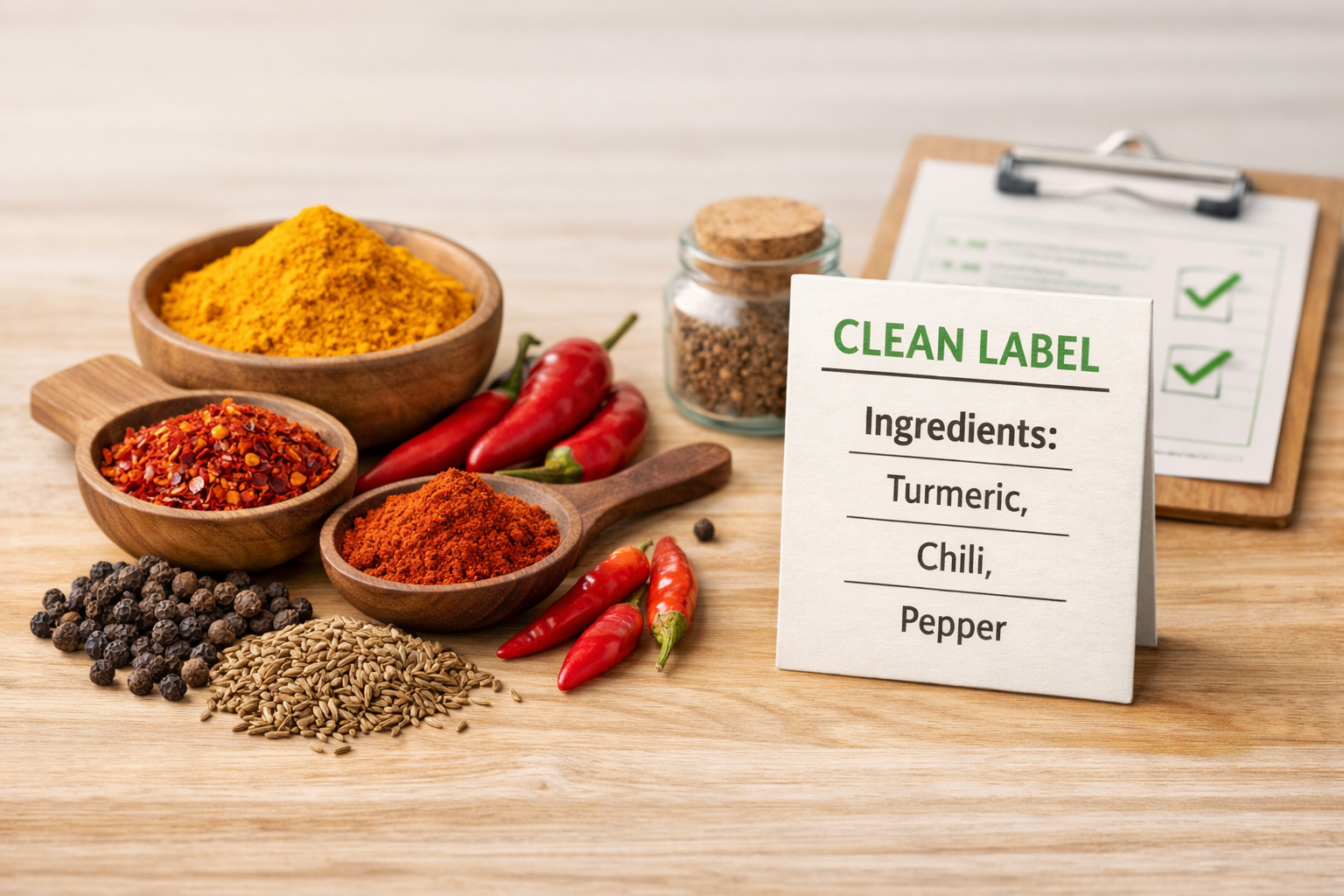
Clean label is one of the most used phrases in food product development, but it is also one of the least precise. In spice ingredient sourcing, that matters.
For European food manufacturers, distributors, and private-label developers, clean label is rarely about one claim or one specification. It is usually about whether an ingredient supports a simpler declaration, a more recognisable ingredient list, and a lower-friction story for internal approval and customer acceptance.
That is why clean label spice ingredients should be evaluated as a sourcing and formulation question, not just a marketing phrase.
Clean label is a market expectation, not a legal definition
In most B2B buying conversations, clean label is not treated as a formal legal standard. It is a commercial shorthand.
Depending on the application, buyers may use it to mean:
- fewer additives on pack
- recognisable ingredient names
- minimal processing perception
- no unnecessary carriers, colours, or anti-caking systems
- documentation that supports internal QA and customer review
This is where confusion often begins. A spice ingredient may be natural in origin, but still create label-declaration complexity if it contains added carriers, processing aids, or functional additives that do not fit the end-product brief.
For procurement teams, that means clean label sourcing cannot be reduced to price per kilo. It has to be linked to final product positioning and the label strategy behind it.
What clean label usually means in spice sourcing practice
When buyers ask for clean label spice ingredients, they are usually looking at a combination of technical and commercial factors.
1. Simpler ingredient declarations
The first question is whether the spice or seasoning system helps keep the ingredient list straightforward.
For example, a ground spice, cut herb, or blended seasoning may appear simple at first glance, but the commercial reality depends on composition. Is it a single ingredient? Is it blended with starches, carriers, or anti-caking agents? Are there added flavouring components that change how the ingredient must be declared?
For R&D and product-development teams, this matters early. A promising flavour system can become less attractive if it forces a more complex pack declaration than expected.
2. Predictable sensory performance
Clean label does not mean much if the ingredient is inconsistent.
If a manufacturer removes flavour enhancers, artificial flavouring, or other declaration-heavy tools, the spice ingredient itself has to do more work. That increases the importance of colour, aroma, heat profile, oil content, cut size, and batch-to-batch consistency.
In other words, clean label often raises the commercial value of raw ingredient performance.
3. Fewer formulation trade-offs
A clean label brief often creates pressure elsewhere in the system. Salt reduction, simpler declarations, and shorter ingredient lists can all expose flavour gaps.
That is why spice ingredients are frequently used not just for taste, but for structure within the flavour profile. Warmth, depth, top notes, roasted character, savoury lift, and visual identity may all need to come from the spice system rather than from added complexity elsewhere.
This makes sourcing quality more important, not less.
Why source quality matters more in clean label development
In conventional product systems, formulators may have more tools available to correct inconsistency. In clean label development, tolerance for weak raw material performance is usually lower.
A clean label spice brief therefore depends on disciplined sourcing in three areas.
Batch consistency
Buyers need confidence that the approved profile can be repeated at production scale. That includes sensory attributes, particle size, moisture discipline, and the physical behaviour of the ingredient in the application.
This is especially important for bakery, snacks, sauces, prepared foods, beverage applications, and seasoning systems where spices carry a visible share of the final eating experience.
Documentation and specification clarity
A clean label conversation quickly moves into technical documentation. Teams typically need a specification that clearly defines what the ingredient is, how it is processed, and what is or is not added.
That internal clarity helps R&D, QA, regulatory, and procurement stay aligned. It also reduces delays during customer onboarding or private-label approval.
Fit for the intended application
The right clean label spice ingredient for a dry blend may not be the right one for a sauce, beverage, or extrusion system.
Mesh size, flow behaviour, colour strength, dispersibility, and thermal stability can all influence whether a spice works commercially in the intended product. Buyers should treat clean label suitability as application-specific, not generic.
Questions buyers should ask suppliers
A useful clean label sourcing discussion is usually specific. Instead of asking a supplier whether an ingredient is “clean label,” buyers get better answers when they ask operational questions.
Ask about composition
- Is this a single-ingredient spice, a blend, or a compounded system?
- Are any carriers, anti-caking agents, or other functional additions used?
- What will the ingredient declaration typically look like?
Ask about performance
- What sensory attributes are controlled batch to batch?
- How does the ingredient perform in heat processing, blending, or liquid systems?
- What ranges are typical for colour, aroma, heat, or volatile oil where relevant?
Ask about documentation
- What specification and batch-linked quality documents are available?
- How is lot identification managed?
- What sourcing and processing records can be shared during qualification?
These questions do two things at once: they reduce sourcing risk and speed up product-development decisions.
Clean label is not the same as “nothing added” in every case
One practical issue for buyers is that clean label targets vary by category, market, and customer expectation.
A seasoning designed for industrial convenience may include functional components that make operational sense in manufacturing, even if they do not fit a stricter clean label brief. That does not automatically make the ingredient unsuitable. It simply means the buyer needs to match the ingredient architecture to the commercial goal.
This is why experienced sourcing teams avoid broad assumptions. They define the declaration outcome they want, the process performance they need, and the documentation standard required for approval.
Then they source to that brief.
The commercial takeaway for EU-facing teams
For EU-bound product development, clean label spice ingredients should be viewed as part of a wider decision framework.
R&D wants flavour delivery and formulation stability. Procurement wants supply continuity and specification discipline. QA wants documentation clarity and consistent batch control. Commercial teams want an ingredient story that is credible, simple, and usable with customers.
The best sourcing decisions sit at the intersection of all four.
That is why clean label is not just about removing things. It is about selecting spice ingredients that make the finished product easier to formulate, easier to explain, and easier to standardise across repeat production.
A better way to evaluate clean label spice ingredients
A practical shortlist for buyers looks like this:
- clear composition
- application fit
- consistent sensory performance
- straightforward specification language
- batch-linked quality documentation
- commercial viability at scale
If a supplier can support those points, the clean label conversation becomes more concrete and more useful.
If your team is reviewing spice ingredients for a cleaner declaration, a reformulation project, or a new EU-facing product line, talk to our team. We can help you assess ingredient options against your application brief, specification needs, and sourcing requirements before you commit to scale-up.